
Product Comparisons
RB1600 vs RB2500 vs RB4000: Self-Loading Concrete Mixer Comparison
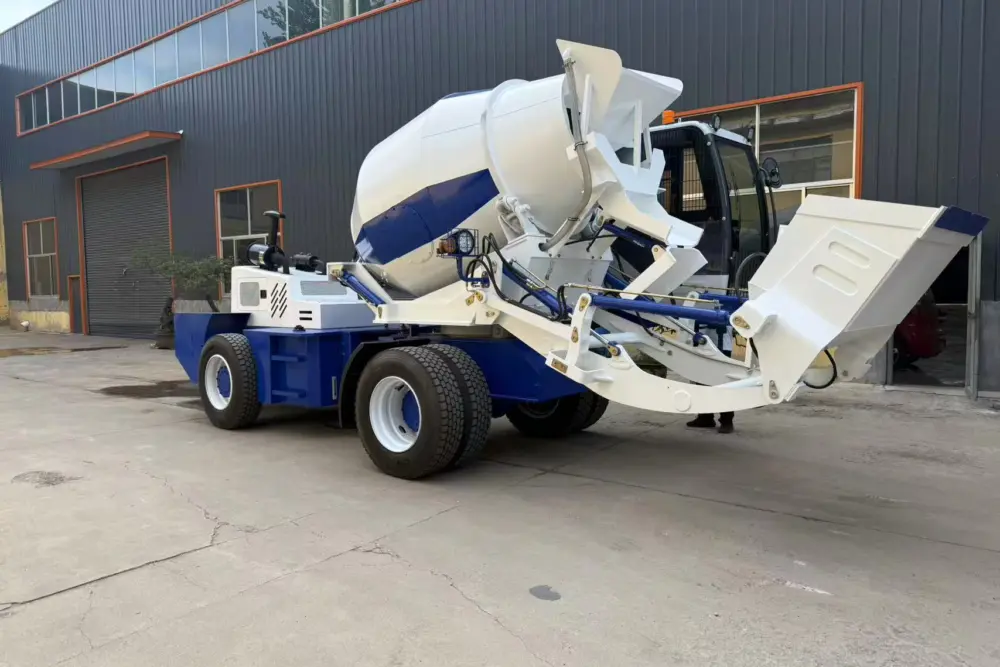
RB1600, RB2500 and RB4000 are three self-loading concrete mixers with different documented capacities, weights, dimensions, engines and discharge features. The model names do not by themselves tell a buyer how much finished concrete is produced or whether the machine fits a particular route.
This comparison uses the controlled Ray Bridge product data. The most important limitation is clear: RB4000 has a confirmed 4 m³ drum capacity, but its concrete yield per batch is not stated in the supplied specification and remains TBD.
Comparison Table
| Specification | RB1600 | RB2500 | RB4000 |
|---|---|---|---|
| Concrete yield | 1.6 m³/batch | 2.5 m³/batch | TBD |
| Drum capacity | 2.5 m³ | 4.5 m³ | 4 m³ |
| Listed batch rate | Up to 4/hour | Up to 4/hour | Not stated |
| Rated power | 58 kW | 76 kW | 92 kW |
| Operating weight | 5,200 kg | 6,900 kg | 8,300 kg |
| Maximum speed | 25 km/h | 35 km/h | 25 km/h high range |
| Drive | Hydraulic 4WD | Hydraulic 4WD | Full-hydraulic 4WD |
Compare Concrete Yield First
RB1600 lists 1.6 m³ concrete yield per batch. RB2500 lists 2.5 m³. These are the appropriate figures for initial batch-volume planning.
RB4000 does not have a documented yield in the current source. Its 4 m³ value is labelled drum capacity and must not be promoted as finished concrete output. Request updated evidence before using a yield value in a schedule or sales claim.
Keep Drum Capacity Separate
The drum figures are 2.5 m³ for RB1600, 4.5 m³ for RB2500 and 4 m³ for RB4000. A larger geometric drum number does not directly establish greater finished yield. Machine design and the documented batch definition matter.
When comparing quotations, require both fields to be named. A table that says only “capacity” is incomplete because buyers may interpret it as output while the seller means drum volume.
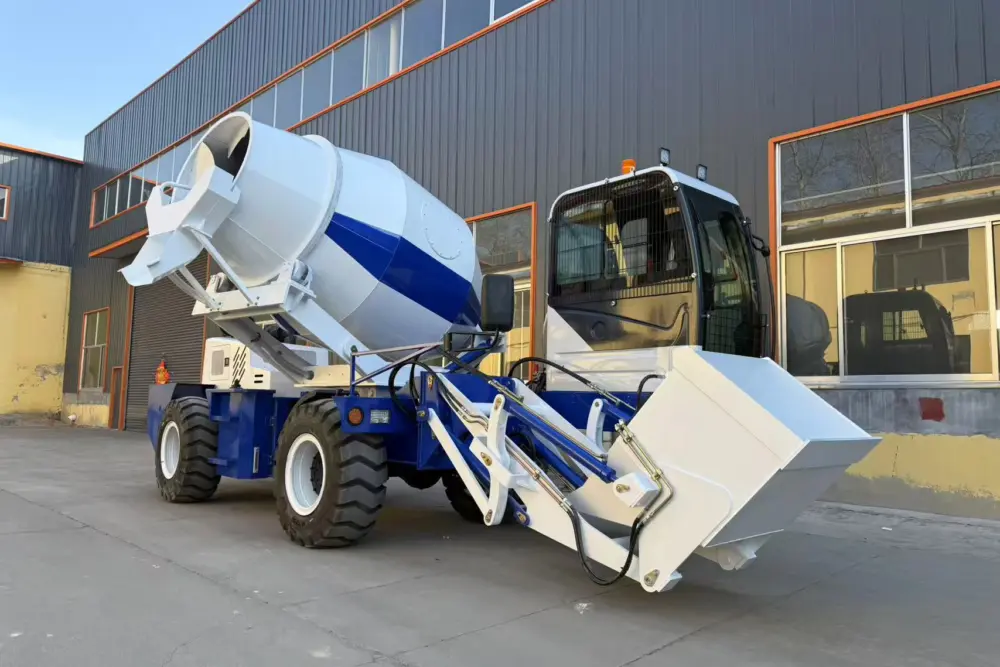
Calculate Only from Confirmed Values
RB1600 and RB2500 each list up to four batches per hour. Multiplying the listed maximum rate by confirmed yield gives arithmetic ceilings of 6.4 m³/h and 10 m³/h respectively. Actual output can be lower because the complete cycle includes loading, water, mixing, travel, discharge and other site time.
There is no equivalent supported hourly calculation for RB4000 because neither its concrete yield nor its batch rate is confirmed in the current record.
Power and Engine Comparison
RB1600
The RB1600 lists a YN27GBZ water-cooled diesel engine rated at 58 kW.
RB2500
The RB2500 lists a Yunnei YN38GBZ water-cooled diesel engine rated at 76 kW.
RB4000
The RB4000 lists a Yunnei YN48GBZ rated at 92 kW at 2,200 rpm.
Power should not be used as a substitute for yield. It is one machine characteristic among capacity, weight, dimensions, drive, discharge and site conditions.
Dimensions and Site Access
RB1600 is listed at 6,750 × 2,350 × 2,450 mm. RB2500 is 6.8 × 2.3 × 2.9 m. RB4000 is 7,700 × 2,580 × 3,450 mm. Compare these envelopes with gate width, overhead clearance, road width and available working area.
RB4000 also lists a 5.5 m minimum turning radius. The same field is not present in the controlled RB1600 and RB2500 tables, so their turning radii should not be guessed.
Operating Weight and Route Planning
The published operating weights are 5,200 kg, 6,900 kg and 8,300 kg. These affect transport and supporting-surface checks. They do not alone determine which machine is more stable or more productive.
Confirm the final weight with options and any shipping dimensions. Assess bridges, ramps, unloading equipment and the actual jobsite route.
Drive, Speed and Grade Information
All three models list four-wheel drive in hydraulic form. Maximum speeds are 25 km/h for RB1600, 35 km/h for RB2500 and 0–25 km/h in RB4000 high range, with 0–9 km/h low range.
RB4000 lists 30% gradeability. This is a percentage, not 30 degrees. Surface, load and operating rules matter, so it is not a universal permission to work on any 30% grade.
Drum and Discharge Features
RB1600 lists a drum rotation range of 0–16 rpm. RB4000 lists 19–21 rpm. RB2500’s controlled table focuses on 270° discharge rotation.
RB4000 adds 270° drum swing, chute swing of at least 60° and hydraulic chute-angle control. These may assist placement planning, but the exact working position and supplied components should be checked.
Weighing and Grade Settings
RB4000 explicitly lists computer-controlled weighing and C15, C20, C25 and C30 grade settings. The current RB1600 and RB2500 controlled tables do not contain the same claim. Do not apply a feature from one model to the whole range.
Concrete performance still depends on inputs, moisture, calibration, mixing and project quality procedures. A setting label is not a strength guarantee.
When RB1600 May Fit the Shortlist
Consider RB1600 when 1.6 m³ batch yield aligns with the pour plan and its 5,200 kg weight and 2,450 mm height suit access. Check the 58 kW engine, tyre specification, water and discharge configuration in the final order.
When RB2500 May Fit the Shortlist
Consider RB2500 when 2.5 m³ batch yield and 270° discharge rotation align with the work, while its 6,900 kg weight and 2.9 m height fit the route. Use realistic cycles rather than the “up to four” rate as a guarantee.
When RB4000 May Fit the Shortlist
Consider RB4000 when its documented weight, dimensions, 4 m³ drum, weighing system and discharge geometry match the required configuration. Do not approve it by output target until concrete yield is confirmed.
Build a Project Comparison Sheet
- Concrete volume per individual pour
- Total volume per shift
- Realistic loading-to-discharge cycle
- Maximum acceptable batch size
- Material and water layout
- Width, height and turning constraints
- Ground and route restrictions
- Required weighing and discharge equipment
- Destination documents and engine requirements
- Written warranty, parts and assistance terms
Do Not Rank Models by Name Alone
A higher number does not prove higher finished output. RB2500 has a 4.5 m³ drum and 2.5 m³ yield, while RB4000 has a 4 m³ drum and unresolved yield. Read labels and evidence rather than assuming a simple model hierarchy.
Compare the current mixer range and individual RB1600, RB2500 and RB4000 pages.
Compare Individual Pour Size, Not Only Daily Volume
A project requiring 20 m³ in a day may consist of one continuous placement or many smaller structures. Those are different workflows. Record the maximum practical batch at each placement, the time between pours and whether unused material can be avoided through scheduling.
RB1600’s confirmed 1.6 m³ yield and RB2500’s 2.5 m³ yield give different planning increments. RB4000 cannot be placed on the same yield comparison until its output is documented.
Review the Loading Area
Machine dimensions are only part of access. The loading bucket also needs a safe approach to stockpiles, and the route must allow the machine to leave without conflicting with material deliveries. Record surface condition, drainage, visibility and separation from people.
For RB4000, the 0.6 m³ loader bucket is documented. Do not copy that value to RB1600 or RB2500. Request the relevant loading-system data when it affects cycle planning.
Review the Order Evidence
For every shortlisted model, request a final specification, included equipment list, engine information, tyres, weighing and water systems, discharge configuration and operating documentation. Add destination certificates, inspection evidence, warranty, parts and assistance only when the applicable terms are confirmed.
A clean comparison has three statuses: confirmed, not applicable and TBD. It should never convert missing information into a feature simply to make all columns look complete.
Think in Constraints Before Preferences
Eliminate any model that exceeds a fixed route, height, weight or pour constraint. Only then compare preferences such as higher power or wider discharge movement. This order reduces the risk of choosing an attractive specification that cannot be used at the site.
A Final Shortlist Review
Ask one person to read the comparison without seeing the model names and select only from the requirements. This helps reveal whether a higher model number or larger power figure is influencing the decision more than yield and access.
Next, verify each decisive field against the current product page and source record. Confirm which items are standard, optional or TBD. Finally, connect the selected machine to the written commercial package: supplier, price, inspection evidence, documents, warranty, parts and delivery responsibility.
This review does not guarantee project performance, but it makes the basis of the purchase visible and auditable.
Compare Maintenance and Support as Contract Terms
A model comparison is incomplete if a buyer assumes identical maintenance documents, parts or assistance. Ask what manual accompanies the machine, which initial parts are included and how later requests are identified. Confirm warranty coverage, exclusions and claim evidence in the sales agreement.
These terms may influence a purchase, but the current product data does not support one universal promise across all three models.
Document every decision.
Frequently Asked Questions
Which Ray Bridge self-loading mixer has the highest confirmed yield?
RB2500, at 2.5 m³ per batch. RB1600 lists 1.6 m³; RB4000 yield is TBD.
Why does RB2500 have a larger drum figure than RB4000?
The supplied records list 4.5 m³ drum geometric capacity for RB2500 and 4 m³ drum capacity for RB4000. Model names should not replace documented labels.
Which model is the lightest?
RB1600 at 5,200 kg, compared with 6,900 kg for RB2500 and 8,300 kg for RB4000.
Which model has 270-degree discharge?
RB2500 lists 270° discharge rotation. RB4000 lists 270° drum swing. Confirm the exact mechanism and supplied equipment.
Can I calculate RB4000 output from its drum size?
No reliable yield should be created from drum capacity alone. Request a source that explicitly states concrete yield per batch.
Which model should I buy?
Select by confirmed yield, pour size, realistic cycle, access, weight, discharge needs and written order terms. There is no universal best model.