
Applications
Self-Loading Concrete Mixers for Road, Rural and Remote Jobsites
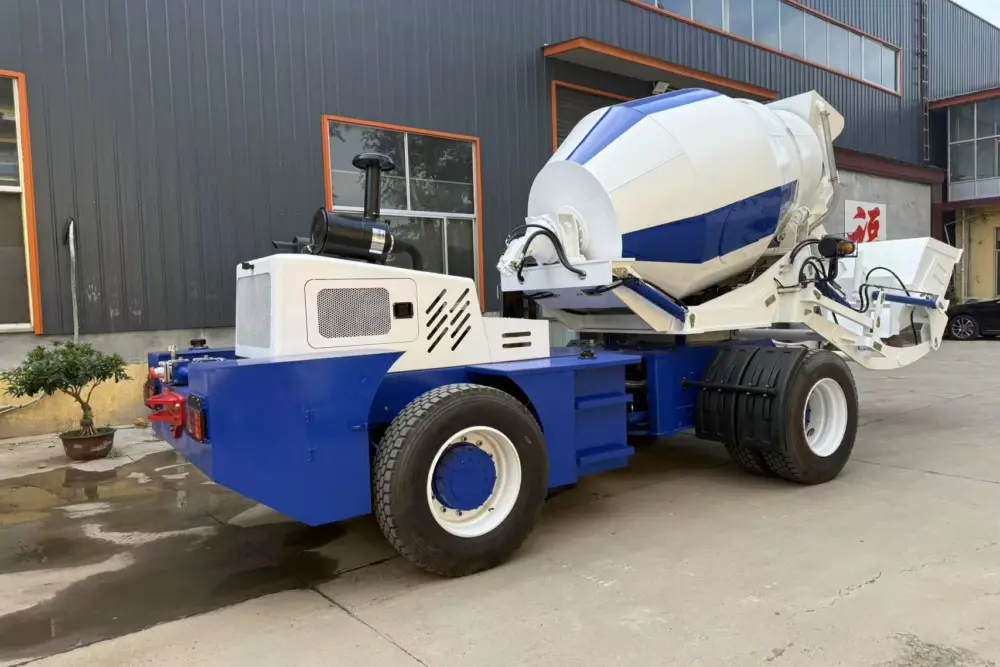
Road, rural and remote projects often distribute concrete work across several locations rather than one fixed placement point. A self-loading concrete mixer may be considered when its loading, mixing, travel and discharge functions match that layout. The decision still depends on confirmed batch yield, access, materials, placement and order terms.
This guide compares the documented RB1600, RB2500 and RB4000 without claiming that one machine automatically replaces a batching plant, transit fleet or workforce. Project economics and suitability require site-specific evidence.
Define the Application Before Choosing Capacity
“Road project” or “remote jobsite” is too broad for selection. List each pour, its volume, timing and location. Record material storage, water, travel distance, route condition, discharge position and any height or weight restriction.
For rural structures, the important unit may be concrete per culvert, slab or foundation rather than total monthly volume. For road alignment work, movement between placement points may dominate the cycle. For a remote site, replenishment and service planning may be critical.
Use Concrete Yield as the Batch Unit
RB1600 lists 1.6 m³ yield per batch. RB2500 lists 2.5 m³. RB4000 yield is TBD; its 4 m³ figure is drum capacity only.
Match the confirmed batch unit to individual pours. Do not select RB4000 by assuming its drum size equals output. Ask for model-specific yield evidence before scheduling production.
Estimate the Complete Cycle
A cycle includes loading, adding water, mixing, travelling, discharging and returning, plus necessary checks or cleaning. RB1600 and RB2500 list up to four batches per hour, but actual cycles depend on the site.
Map the material-to-pour route. A short theoretical mixing time does not create high output if the machine waits at a stockpile or placement point.
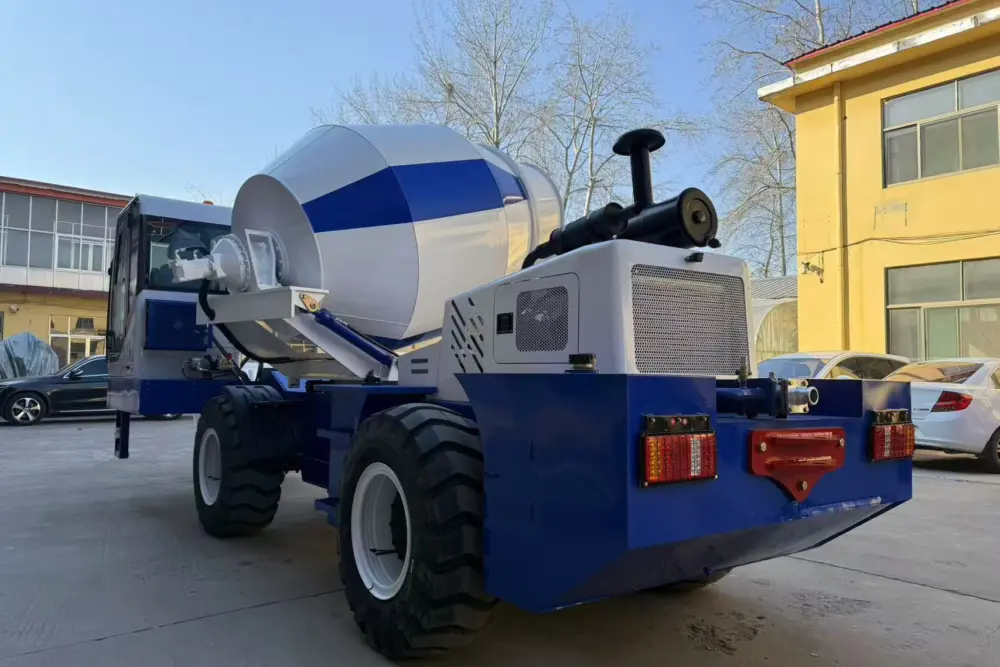
Compare Site Access
RB1600 access profile
RB1600 measures 6,750 × 2,350 × 2,450 mm and weighs 5,200 kg. These are useful where height or route weight is a screening constraint.
RB2500 access profile
RB2500 measures 6.8 × 2.3 × 2.9 m and weighs 6,900 kg. It has the narrowest published width among the three, but every dimension and turning requirement must be considered together.
RB4000 access profile
RB4000 measures 7,700 × 2,580 × 3,450 mm, weighs 8,300 kg and lists a 5.5 m minimum turning radius. Confirm that the complete route and work area can accommodate it.
Do Not Convert Grade Percentage to Degrees
RB4000 lists 30% gradeability. Percentage grade and angle are different expressions. Keep the published value as 30% unless a calculation is explicitly made and clearly labelled. More importantly, do not treat the value as approval for any particular slope.
Surface, moisture, load, direction of travel and operating instructions affect safe movement. Site assessment remains necessary for all three models.
Plan Material and Water Supply
A self-loading mechanism does not create aggregates, cement or water. Establish where materials will be stored, protected and replenished. Check whether the machine can approach without contaminating materials or conflicting with people and vehicles.
The concrete design and quality controls belong to the project. Confirm the machine’s included weighing and water equipment, calibration requirements and operating procedure.
Compare Weighing and Controls Carefully
The RB4000 specifically lists computer-controlled weighing and C15, C20, C25 and C30 grade settings. The current controlled tables do not repeat those claims for RB1600 or RB2500.
A grade setting is not a guarantee of achieved strength. Material properties, moisture, proportions, mixing, sampling and curing remain part of the project quality process.
Review Discharge at Each Pour Point
RB2500 lists 270° discharge rotation. RB4000 lists 270° drum swing, chute swing of at least 60° and hydraulic chute-angle control. Confirm what the selected machine can reach from a safe standing position.
Some placements may require a separate chute, pump or other method. The application should determine the equipment, not the other way around.
Use Power and Speed as Supporting Data
RB1600 lists 58 kW and 25 km/h maximum speed. RB2500 lists 76 kW and 35 km/h. RB4000 lists 92 kW at 2,200 rpm with 0–25 km/h high range and 0–9 km/h low range.
These figures do not predict daily output or safe route speed. Use observed or conservatively estimated travel time in cycle calculations.
Road Project Selection Questions
- How many pour points are spread along the route?
- What is the volume and timing of each pour?
- Where are aggregate, cement and water stored?
- What width, height, grade and bridge limits exist?
- Can the machine stand safely at each discharge point?
- Which inspection and destination documents are required?
Rural Infrastructure Selection Questions
List culverts, drains, slabs, crossings and other concrete elements separately. Small placements can make batch size and movement more important than a single daily total. Check whether materials can be stored consistently and whether weather or access changes the route.
Do not publish savings or labour reductions without measured evidence from the real project. Compare alternatives using local prices, people, transport and time.
Remote Jobsite Selection Questions
Remote work increases the importance of planning what happens when materials, parts or technical assistance are not immediately available. Ask for a model-specific parts list, current availability, estimated lead time and written support scope.
No universal Ray Bridge long-term parts or on-site service promise is supported by the current evidence. Include required initial spares and responsibilities in the agreement.
When a Self-Loading Mixer May Not Fit
The machine may not fit if the route is too narrow or weak, the batch size conflicts with placement, materials cannot be controlled, or the project requires continuous high-volume plant production. A different concrete supply and placement system may be more appropriate.
A responsible selection can conclude that none of the models fits. This is better than forcing a machine into the wrong workflow.
Model Shortlisting
RB1600
Shortlist when 1.6 m³ batch yield and the 5,200 kg, 2,450 mm-high access profile fit. Confirm all order-specific equipment and terms.
RB2500
Shortlist when 2.5 m³ yield, 270° discharge rotation and its dimensions fit the planned pours and route.
RB4000
Shortlist when its documented drum, weighing, swing, power, weight and dimensions fit, but keep output unresolved until yield evidence is supplied.
Request a Written Configuration
The quotation should identify concrete yield, drum capacity, engine, drive, tyres, weighing system, water and discharge equipment, dimensions, inspection evidence, documents, warranty, parts and assistance. Mark unsupported fields TBD.
Compare the Road Construction, Rural Infrastructure and Remote Jobsites pages with the product range.
Compare Alternatives with Local Evidence
A self-loading mixer should be compared with the alternatives actually available to the project, using local quotations and measured logistics. Include material supply, transport, setup, operators, placement equipment, inspection and downtime assumptions. Do not import a savings percentage from another country or contractor.
The conclusion may vary between road sections or seasons. Keep the calculation separate from the product specification so commercial assumptions can be updated without changing machine facts.
Prepare the Site Before the Machine Arrives
Confirm material storage, water, access, turning area, discharge points and washout arrangements in advance. Review overhead and underground hazards, traffic separation and supporting surfaces. These controls are project responsibilities and must follow local requirements and the final operating manual.
If the route changes with weather or construction progress, repeat the access check. A dimension that fits the original entrance does not prove every future work point is reachable.
Write Remote-Support Expectations into the Contract
For a distant site, define the support contact, language, hours, evidence required for a claim and responsibility for parts, freight and labour. If on-site attendance is important, it must be explicitly agreed; it should not be inferred from a general “after-sales service” statement.
Keep critical parts planning model-specific. The current knowledge base does not establish one universal initial-spares package or long-term availability promise.
Final Application Review
Before approving a model, walk the planned material-to-pour route and compare every restriction with the controlled specification. Confirm the concrete batch unit, discharge position and written support terms. If any essential assumption is unsupported, keep it visible as TBD or test it before commitment.
This final check is especially important on remote projects, where correcting a configuration or logistics error may take longer.
Coordinate the Mixer with Placement Work
The machine cycle and the receiving crew must be planned together. Confirm whether forms, reinforcement, access and finishing capacity can accept each batch at the intended time. Waiting at the discharge point reduces completed cycles even if loading and mixing proceed as expected.
Record placement constraints in the same worksheet as yield and route data.
Frequently Asked Questions
Are self-loading mixers suitable for remote sites?
They may be considered when confirmed yield, access, materials, discharge and support terms match the site. Remote location alone does not prove suitability.
Which mixer is suitable for small rural pours?
Compare each pour volume with the confirmed 1.6 m³ RB1600 and 2.5 m³ RB2500 batch yields. Also check access and cycle time.
Can a self-loading mixer work on road projects?
It can be evaluated for dispersed concrete placement, but route, standing area, materials and discharge requirements must be checked.
Does four-wheel drive guarantee off-road access?
No. Drive type is one feature. Surface, grade, weight, tyres, weather and safe operating rules also matter.
What spare parts should be taken to a remote site?
Request a model-specific list and select initial spares based on the agreement, maintenance plan and local availability. Do not assume a universal package.
How do I choose between RB1600, RB2500 and RB4000?
Use confirmed yield, batch size, route dimensions, weight, discharge and control requirements. RB4000 yield must be confirmed before output-based selection.