
Buying Guides
What Is a Self-Loading Concrete Mixer? Working Cycle, Capacity and Selection
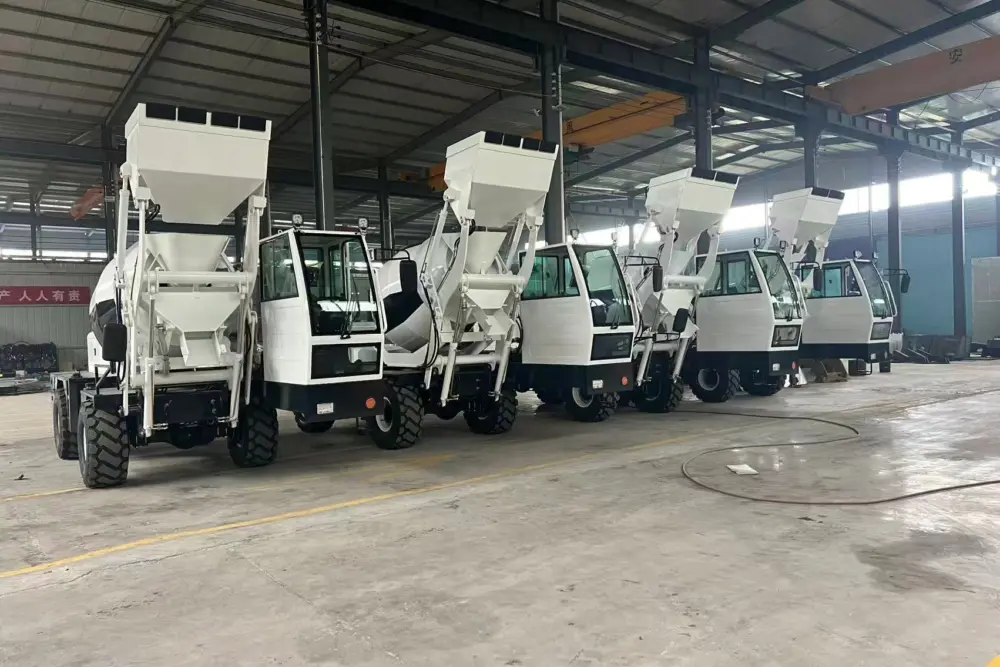
A self-loading concrete mixer combines material loading, on-board mixing, movement around a jobsite and concrete discharge on one wheeled machine. Buyers often describe it as a mobile batching solution, but the exact equipment fitted and the amount of concrete produced must be checked model by model.
This guide explains the working sequence and the confirmed Ray Bridge RB1600, RB2500 and RB4000 specifications. It does not assume that every machine has the same weighing, water, steering or control system. Options and operating procedures must be confirmed from the final specification and manual.
What Makes a Concrete Mixer Self-Loading?
The identifying feature is a loading system that places concrete ingredients into the mixing drum without depending on a separate loader for every batch. The machine then rotates the drum to mix the materials and can travel within the limits of its design before discharging.
That combined workflow distinguishes it from a conventional drum that only receives preloaded material. It does not eliminate the need for planned stockpiles, water supply, cement handling, mix control, trained operation or safe cleaning.
The Basic Working Cycle
1. Prepare materials and the work area
Aggregates, cement and water must be available in a layout the machine can approach safely. Material properties and the required concrete design are project inputs, not facts the machine can decide by itself.
2. Load the ingredients
The loading bucket collects material and transfers it toward the drum. Bucket capacity and weighing equipment vary by model. The RB4000 record lists a 0.6 m³ loader bucket and computer-controlled weighing; equivalent details should be checked separately for RB1600 and RB2500.
3. Add water and mix
The drum rotates while the ingredients are combined. The RB1600 lists a drum speed of 0–16 rpm. The RB4000 lists 19–21 rpm. A drum-speed number alone does not define mix quality or mixing time; follow the confirmed manual and project mix requirements.
4. Move to the placement point
The machine can travel around the site subject to access, surface, load and safe-operation constraints. Published maximum speeds are 25 km/h for RB1600, 35 km/h for RB2500 and 25 km/h in the RB4000 high range. These are maximum specification values, not expected cycle speeds.
5. Discharge and clean
Discharge geometry affects where the machine can place concrete. RB2500 lists 270° discharge rotation. RB4000 lists a 270° drum swing, a chute swing of at least 60° and hydraulic chute-angle control. Cleaning requirements belong to the operating manual and site procedure.
Concrete Yield Is Not Drum Capacity
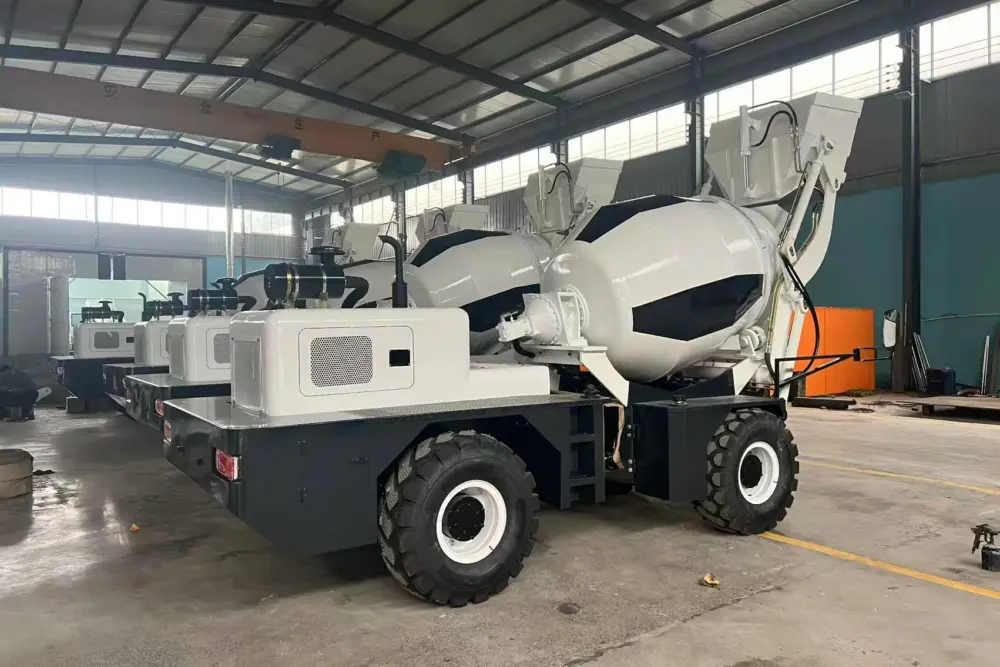
This is the most important capacity distinction. Drum geometric capacity describes the drum volume. Concrete yield per batch describes the stated amount of concrete produced. They are not interchangeable.
- RB1600: 2.5 m³ drum geometric capacity and 1.6 m³ concrete yield per batch
- RB2500: 4.5 m³ drum geometric capacity and 2.5 m³ concrete yield per batch
- RB4000: 4 m³ drum capacity; concrete yield per batch is TBD because the supplied specification does not state it
Do not advertise the RB4000 as a 4 m³ output machine based only on the drum number. The yield must be confirmed by reliable product evidence.
How the Three Ray Bridge Models Differ
RB1600
The RB1600 is listed with 1.6 m³ concrete yield per batch, 2.5 m³ drum capacity, 58 kW rated power, 5,200 kg operating weight and dimensions of 6,750 × 2,350 × 2,450 mm. It uses a YN27GBZ water-cooled diesel engine and hydraulic four-wheel drive.
RB2500
The RB2500 lists 2.5 m³ yield, 4.5 m³ drum capacity, 76 kW rated power, 6,900 kg operating weight and overall dimensions of 6.8 × 2.3 × 2.9 m. Its engine is listed as Yunnei YN38GBZ, and the specification includes hydraulic four-wheel drive and 270° discharge rotation.
RB4000
The RB4000 lists 4 m³ drum capacity, 92 kW at 2,200 rpm, 8,300 kg operating weight and dimensions of 7,700 × 2,580 × 3,450 mm. It has full-hydraulic four-wheel drive, a computer-controlled weighing system and specified C15, C20, C25 and C30 concrete-grade settings. Its concrete yield remains TBD.
What Does “Batches per Hour” Mean?
The RB1600 and RB2500 records list up to four batches per hour. “Up to” is essential. It is not a guaranteed hourly production rate for every jobsite. Loading layout, material handling, water supply, travel distance, discharge, cleaning and operator procedure can change the cycle.
A planning estimate can multiply confirmed yield by a realistic batch count, but the batch count must come from the site. At the listed maximum, the arithmetic ceiling would be 6.4 m³ per hour for RB1600 and 10 m³ per hour for RB2500. These are calculations from two published values, not guaranteed output.
Access and Operating Weight
Before selecting capacity, verify that the machine can reach and work at the pour points. Compare the narrowest route, lowest clearance, turning area and supporting surface with the dimensions and operating weight.
RB1600 is 5,200 kg, RB2500 6,900 kg and RB4000 8,300 kg. The RB4000 also lists a 5.5 m minimum turning radius and 30% gradeability. A percentage grade is not the same as a degree value and should not be converted or relabelled without an explicit calculation and context.
Power and Drive Data
Rated power rises across the published models: 58 kW for RB1600, 76 kW for RB2500 and 92 kW for RB4000. All three list a form of hydraulic four-wheel drive. These values help compare machines but do not independently predict output, fuel use or ability on a particular surface.
Ask for the exact engine and drive configuration in the quotation, especially if destination rules require particular engine or emissions evidence.
Weighing and Concrete Control
The RB4000 record explicitly lists computer-controlled weighing and concrete-grade settings. A buyer should still ask what is measured, how calibration is handled and which operating instructions apply. The current verified tables do not support copying that same claim to RB1600 or RB2500.
Concrete quality depends on the materials, proportions, moisture, mixing and project controls. A product feature should not be turned into a blanket concrete-strength guarantee.
Where a Self-Loading Mixer May Be Considered
Potential use environments include road structures, rural works, building sites and remote jobsites where concrete is placed at several points. The correct machine depends on the required yield, batch size, route, discharge access and material arrangement.
It may not be the right choice where a high-volume continuous supply, specialist concrete plant or different placement system is required. Compare the entire process rather than assuming one machine type is always more economical.
Questions to Confirm Before Ordering
- Required concrete volume per pour and per shift
- Confirmed concrete yield, not only drum capacity
- Realistic cycle time for the site layout
- Material and water supply arrangement
- Route width, height, grade and turning space
- Discharge direction and chute requirements
- Weighing and control equipment included
- Final engine, tyres and drive configuration
- Inspection and destination documents
- Warranty, parts and assistance terms in writing
How to Use the Product Pages
Begin with the self-loading mixer overview. Use the individual RB1600, RB2500 and RB4000 tables for controlled values. If a salesperson, old file or external page gives a different number, resolve it before ordering.
What the Machine Does Not Decide
A self-loading mixer provides mechanical functions, but it does not independently approve a concrete mix, determine structural requirements or certify a jobsite. The project team remains responsible for material selection, mix design, testing, placement, curing and compliance with local rules.
Likewise, four-wheel drive and a maximum-speed value do not establish a safe travel plan. The route, slopes, surface, visibility, people and other equipment must be assessed. Use the confirmed manual and trained operation for the exact configuration.
How to Request a Demonstration
If a demonstration or video is required, define what must be shown: model identification, loading system, controls, weighing display if fitted, drum movement, discharge and any agreed measurements. A generic video of a similar machine should not be treated as evidence for the quoted model.
Final Selection Check
Choose a model only after concrete yield, site access, discharge, included controls and the full order terms have been reviewed together. A self-loading mixer is a system within a project workflow; no single capacity, power or speed value proves suitability.
Keep the Specification Current
Save the source date used for the selection and recheck it when the quotation arrives. If a supplier changes the engine, controls, dimensions or capacity labels, request evidence and update the controlled record before repeating the claim. Product pages and order documents should describe the same configuration.
Frequently Asked Questions
How does a self-loading concrete mixer work?
It uses a loading system to place ingredients into an on-board drum, mixes them as specified, moves within the jobsite and discharges at the placement point. Exact controls and equipment vary by model.
What is the difference between drum capacity and concrete yield?
Drum capacity is a volume of the drum. Concrete yield is the stated output of finished concrete per batch. The drum number should not be presented as yield.
How much concrete can a self-loading mixer produce?
Multiply confirmed yield by a realistic number of completed cycles. RB1600 lists 1.6 m³ yield and RB2500 2.5 m³. RB4000 yield is TBD.
Can a self-loading mixer travel with concrete?
The machine is designed to move within its operating context while the drum turns, but route, load, speed and safety requirements must follow the confirmed manual and site controls.
Does every self-loading mixer have a weighing system?
Do not assume so. RB4000 explicitly lists computer-controlled weighing. The fitted system for every quoted model should be confirmed in writing.
Which self-loading mixer size should I choose?
Use pour volume, realistic cycle time, access, operating weight and discharge needs. Choose from confirmed yield values and keep missing data as TBD.